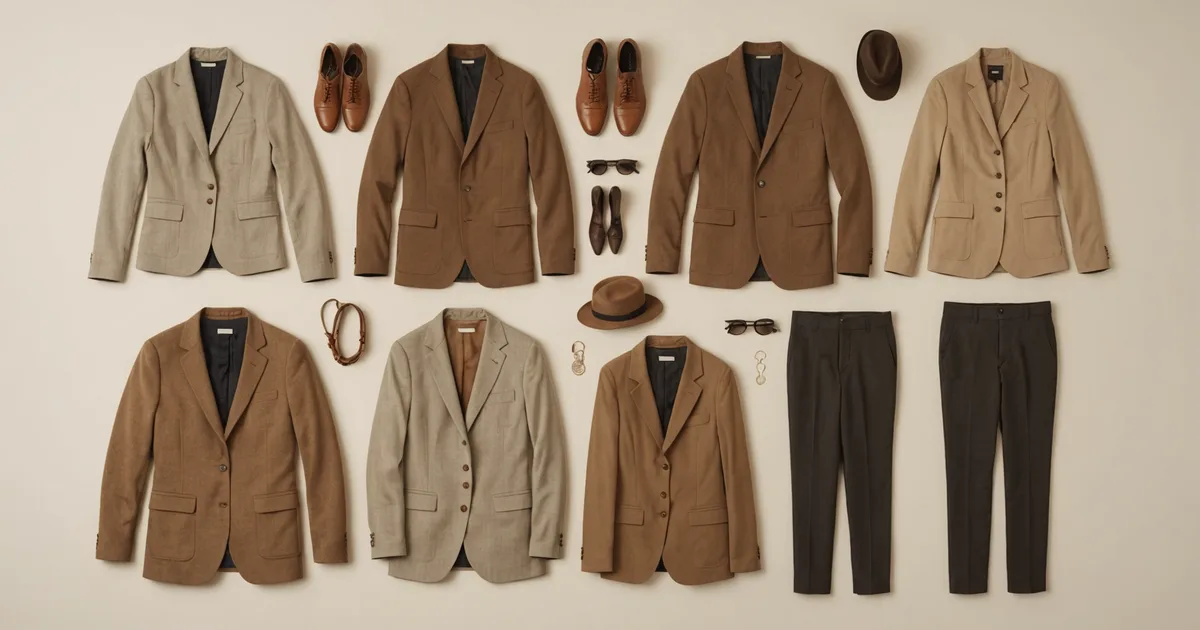
Most capsule wardrobe advice falls into one of two failure modes. The first assumes you have a generous budget and the patience to spend months finding exactly the right pieces before buying anything. The second assumes your life is simple enough that twelve pieces can cover everything, which is true for very few people who work in changing environments, have different social contexts, or live somewhere with actual seasons.
I have been building capsule wardrobes professionally for eight years. The clients who asked me to do this work were never the people in the advice articles. They had real budgets, complicated lives, existing wardrobes they were not going to throw away, and specific constraints around occasions, body fit preferences, and what they were actually willing to maintain and care for. Here is the framework I ended up with.
The starting point is not a number of pieces
The capsule wardrobe industry has settled on a magic number, usually somewhere between fifteen and thirty pieces, as the target. That number is not wrong exactly, but it focuses attention in the wrong place. The starting point for building a functional capsule wardrobe is not "how many pieces" but "how many distinct dressing contexts do you actually have."
For most working adults, the honest answer is three to four. There is the daily professional context, whatever form that takes for your specific work. There is the casual social context, which might include everything from weekends to informal evenings depending on how you live. There is the slightly more formal context for occasions that require it, which varies enormously in frequency. And there is the active or practical context, the clothes you wear when you are doing things that require durability or range of motion over appearance.
Once you have that map, the question becomes how many pieces you actually need per context, and which pieces can legitimately serve more than one. A well-chosen jacket can cross from professional to social. A trouser with a precise enough cut can move across formality registers with the right footwear and top. The work is identifying those crossing points, and that work is where the actual skill of capsule building lives.
What a real budget looks like and how to work within it
Most of the capsule wardrobe advice that references independent labels assumes a budget of $200 to $400 per piece and twelve to twenty pieces, which puts the total investment somewhere between $2,400 and $8,000. That is a real budget for some people. For many others, especially people building a capsule for the first time or rebuilding after a major life change, that number is aspirational not practical.
A more realistic framework is to identify the three to four pieces in your wardrobe that would most improve your daily experience if they were better, and to allocate the majority of your clothing budget for a year to those pieces. This is not a capsule wardrobe in the sense of building everything at once. It is a capsule wardrobe in the sense of being intentional about what gets replaced and in what order.
The independent labels that are most useful for this approach are the ones that sit in the $180 to $350 range per piece: above the price point where construction shortcuts become routine, below the price point where you are paying primarily for a label's positioning rather than for what the garment actually is. That range exists, and within it there are independent labels making interesting work across every garment category. Finding them is harder than it should be, which is partly why Atorie exists, but they are there.
The pieces that earn their keep across contexts
In eight years of working with clients on this, I have found that there are four garment categories that consistently produce the highest return on investment for people building a capsule from a constrained budget, because they are the categories where construction quality most dramatically changes how often you actually reach for the piece.
The first is trousers. A trouser with good drape, a well-set rise, and construction that holds its shape after washing will get worn in circumstances that a trouser with any of those qualities missing will not. I regularly see clients who have five pairs of trousers and only genuinely like two of them. The three they do not like are not bad. They are just not quite right. Replacing those three with one that is genuinely right would produce a better result at lower total cost.
The second is outerwear. This may be obvious, but the multiplier effect of a jacket or coat that works is substantial. One piece worn over everything else shapes the overall impression of a wardrobe in a way that individual other pieces cannot. People consistently underinvest in outerwear relative to what they spend on pieces that get seen less.
The third is knitwear. A sweater or cardigan that has genuine fabric weight and construction integrity wears differently than one that does not. This is a category where the difference between a $95 piece and a $195 piece is often very visible after two years of wear, which means the total cost calculation over a garment's useful life tends to favor the more expensive option.
The fourth is footwear, which is technically outside the clothing capsule, but the relationship between footwear and how the rest of a wardrobe reads is strong enough that it belongs in the same budget conversation. One pair of well-made leather shoes that actually fit will do more for the overall coherence of a wardrobe than any single garment change.
What I tell clients who are not ready to spend more per piece
I am not going to pretend there is a version of this that produces great results on a very limited budget. There is not, in the independent label category specifically. Independent label pricing reflects the actual cost of making things this way: smaller runs, more labor-intensive construction, more careful sourcing. If someone cannot access that price range, that is a real constraint, not a taste failure.
What I tell clients in that position is to focus the budget on the one garment category where they most consistently feel their current wardrobe is failing them, buy the best version of one piece in that category they can genuinely afford, and leave the rest of the wardrobe alone. One piece that works changes the whole wardrobe's register more than many mediocre purchases in the same budget.
The other thing I tell them is that building a capsule wardrobe is a multi-year project for most people, not a single shopping season. The goal is to gradually replace the pieces that are not working with pieces that are, buying better less often rather than buying more at lower quality. That arc, done with some intention, usually gets people to a wardrobe they genuinely like in two to three years. The timeline is longer than the advice articles suggest. The result is more reliable.