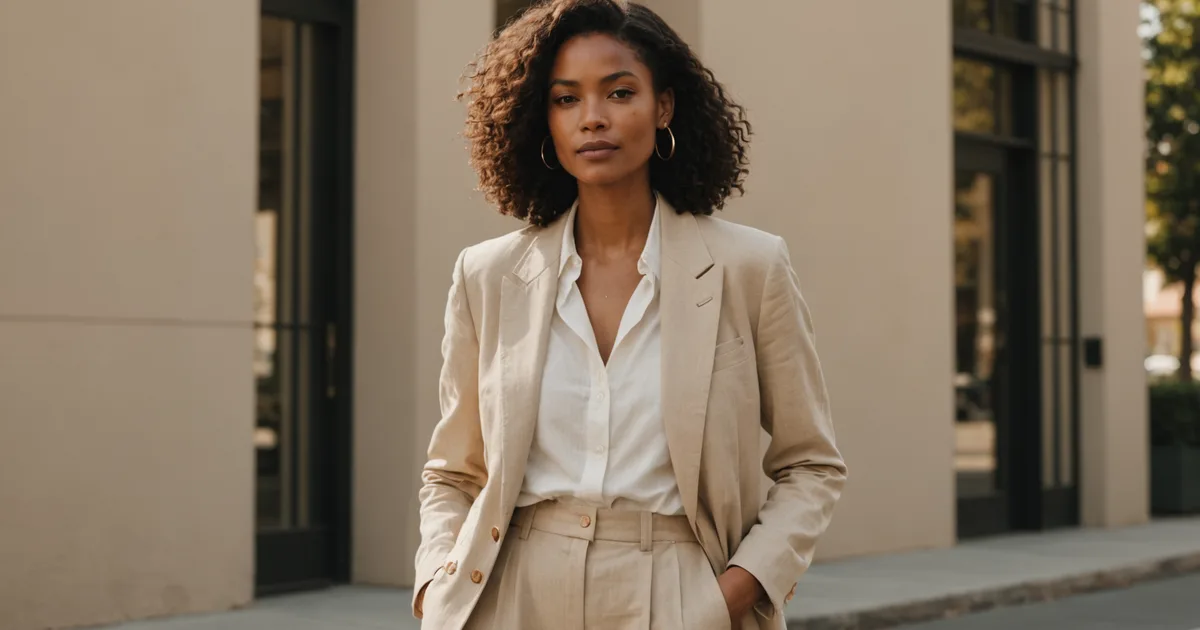
Professional dressing has been in a kind of identity crisis for a decade. The formal conventions of the suit, which once gave everyone a legible language for serious work contexts, have degraded to the point where wearing one in most professional environments now reads as either very conservative or costuming. The reaction against formality, the tech-inflected move toward hoodies and sneakers in professional contexts, solved one problem and created another: it dropped the legibility of professional dress entirely, leaving people with no shared visual vocabulary for what professional actually means.
The interesting work is happening in the space between those two failed defaults. A group of independent labels has been building something that reads as professional without referencing the suit's historical grammar, and doing it in a way that holds up across the shifting context of a workday that moves between a computer screen, a client meeting, public transit, and an informal dinner without a costume change in between.
These are not five specific named labels. Rather, they are five distinct approaches to the problem, each visible in different labels currently in the Atorie index.
The precision-cut trouser as foundation piece
The most consistent approach we see is starting from the trouser and working outward. The trouser is the piece that most directly signals professional register because it reads formal in a way that other garments do not, regardless of what is worn above it. An independent label doing this well is usually working with a high-natural-fiber blend, typically a wool or wool-cotton mix that holds a crease without stiffness, cut with enough precision in the rise and inseam to work on a range of bodies without tailoring. The waistband treatment matters: a clean, narrow waistband reads more contemporary than the wider waistbands of traditional tailoring.
What makes this approach work as workwear is that a trouser with this kind of construction can carry a very casual top without losing its professional register. A t-shirt worn with a well-made, precisely cut trouser reads differently than the same t-shirt with jeans. The trouser does the professional work. The rest of the outfit can be as relaxed as the context allows.
The label approach that does this most thoughtfully extends the trouser line into two or three cuts targeting different body preferences and occasion needs, rather than trying to make one cut serve all purposes. A straighter cut at the ankle for a cleaner silhouette, a wider cut through the leg for more comfortable movement, a cropped option for warmer climates. The key is that all three cuts maintain the same waistband and seam construction standard, so the quality reads consistently across the range.
The unstructured blazer as bridge piece
The second approach builds around an unstructured blazer: a jacket with the silhouette language of a suit jacket but without the padding and stiffening that make traditional blazers difficult to move in and easy to read as formal. The unstructured blazer occupies a useful middle ground. Worn over a collared shirt, it reads as professional. Worn over a t-shirt, it reads as intentional-casual. The same piece reads differently depending on what is under it, which is exactly the kind of wardrobe versatility that works for people whose day moves across contexts.
The construction challenge in an unstructured blazer is drape: without the structure of padding, the shoulder and chest line depends entirely on the cut and the weight of the fabric. Labels doing this well are usually using mid-weight wovens, often a Japanese wool or Italian linen, where the fabric's own weight provides the shape that padding would otherwise create. These garments need to be pressed occasionally rather than steamed, because the construction gives them a natural fall that steaming can disrupt.
Labels doing interesting work in this space are treating the blazer as a design object rather than a utility piece: using interesting seaming, an unusual sleeve placement, or a subtle collar construction to make the garment visually distinct without introducing anything that would read as costume or impractical.
The mid-layer knit that crosses registers
The third approach uses knitwear as the primary register-crossing tool. A well-made mid-weight knit occupies a useful ambiguity: it reads as professional over tailored trousers, as casual over denim, and as polished under an outer layer. Independent labels working in this space are typically using gauge and construction as their differentiating variables rather than color or surface decoration.
A tighter-gauge knit in a clean merino reads more formally than a loose-gauge knit in the same color. An oversized cut through the body with a precise neck and cuff reads more formally than a looser cut throughout. These are construction judgments that show up in how the piece reads in context. The labels doing this most thoughtfully are producing knitwear where the construction intelligence is the design, rather than applying surface-level design decisions (unusual color combinations, visible texture effects, decorative elements) to a straightforward construction.
The textile-forward shirting that replaces the dress shirt
The dress shirt is one of the pieces that most needs replacing in the contemporary workwear vocabulary. The construction conventions of dress shirts, the stiff collar, the tight chest through the armhole, the fabric choice of fine cotton poplin that wrinkles immediately, produce a garment that is demanding to maintain and not very comfortable for a full workday of movement. But the shirt silhouette still reads as professional in a way that other tops do not.
Some independent labels are working with shirt silhouettes in fabrics that do not have those maintenance problems. An overshirt in a mid-weight linen or a Japanese cotton chambray, cut with a slightly more relaxed armhole and a cleaner collar than the dress shirt conventions, reads as professional while being more comfortable and more forgiving of a day's wear. The key construction difference from a casual shirt is usually in the collar, which needs enough structure to read as intentional rather than relaxed, and in the hem, which in a workwear context typically means a slightly more formal bottom than the curved hem of casual shirts.
The outerwear that bridges the commute
The fifth approach is outerwear as context bridge: a coat or jacket that reads appropriately in a professional context but is also functional for the reality of urban commuting, which in most cities means some combination of public transit, weather exposure, and walking. The traditional answer to this was the trench coat, which solved the formality problem but created other ones (belt management, volume at the hem when seated, susceptibility to dirt at the lower panels).
Independent labels working in this space are developing their own answers to the same problem: outer layers with clean silhouettes and appropriate cloth weight for professional contexts that also have practical construction details. A single zip placket rather than buttons. A hood that stows cleanly. An interior pocket configuration that works for commute-level carrying needs. A hem length that falls at a point where it reads formal without collecting on public transit seats. These are practical design decisions that mass market outerwear rarely gets right because the manufacturing economics push toward simpler construction, and workwear-quality independent outerwear is where the best answers are currently being developed.
What connects these five approaches
What these approaches share is a specific design position: professional legibility without formal syntax. They are all making garments that read as appropriate for serious work contexts, but none of them are borrowing the specific visual language of traditional tailoring to do it. That is a distinct and genuinely difficult design problem, and the fact that multiple independent labels are converging on different solutions to it suggests that the problem is real and that the existing mass market options are genuinely not adequate for how people need to dress now.
We are not claiming these labels have fully solved the problem. Some of the pieces we have reviewed in this space work for some body types and occasions and not others. The trouser cut approach requires access to a trouser that actually fits your proportions, and the range of fits currently available from small-batch independent labels is more limited than mass market alternatives. The unstructured blazer approach requires willingness to invest in fabric care. These are real limitations, not dealbreakers, but they are worth knowing about before making a purchase.